Arizona Guided Hunts Outfitters & Guides
General Information
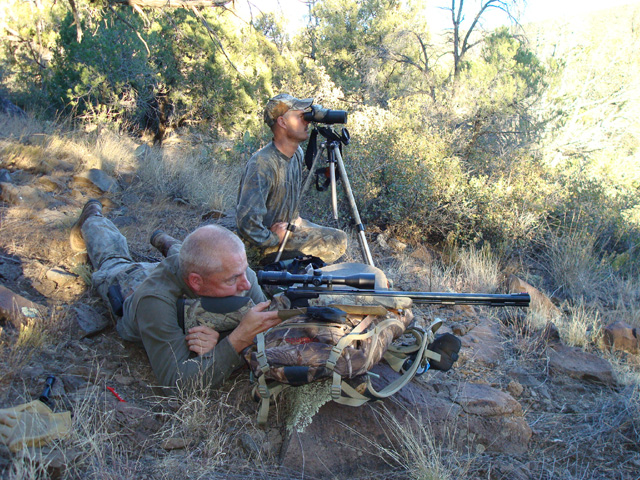
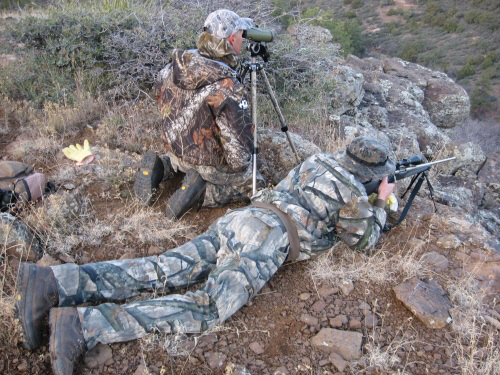
Shooting across a big canyon in the prone position is our typical hunting style.

About Us
Arizona Guided Hunts is based near Tucson and has been guiding hunters in Arizona since 1997. Most of the areas where the outfitter operates are located within hunting areas called Arizona State Trust Lands. Public Federal areas where the outfitter is Special Use Permitted to operate may include certain USDA Forest Service Lands on a case by case basis (primarily Coronado NF or Coconino NF). USFWS National Wildlife Refuges and BLM Lands are also be used via Special Use Permit on a case by case basis and/or depending upon where the hunter is drawn.
The owner, Patrick Feldt, is a very experienced hunter of all big game species within the State. He earned a Bachelor of Science in Renewable Natural Resources with a major in Wildlife and Fisheries Science from the University of Arizona in 1994. This adds to his credibility, passion, and dedication as a full-time outfitter. Outfitting and guiding is not a part-time job for Pat. He typically spends over 220 days/year in the field either scouting for wildlife or guiding hunters. He and his guides are very knowledgeable and experienced with all game species hunted in the Arizona. Their expertise has allowed hunters to take many trophy-class animals while enjoying a well organized operation. Hunter opportunity is very high with AGH. This is not only due to it being a full-time operation that spends extended hours in the field, but they have developed advanced hunting techniques, have experienced guides, and excellent areas. Hunters looking for an Arizona outfitter guide service will find these hunts very professional, exciting and rewarding. Hunters have a great chance at taking home a trophy of a lifetime with Arizona Guided Hunts!
Arizona has a wide variety of game animals to hunt. Arizona Guided Hunts offers various hunting packages for many of these animals including Coues Whitetail Deer, Desert Mule Deer, Javelina, Elk, Desert Bighorn Sheep, Black Bear, Antelope and Gould's Turkey. Hunts can be either archery, rifle, handgun, crossbow, or muzzleloader, depending upon which season or area drawn.
Our Main Guides:
Pat takes pride in having only friendly, personable and "team-oriented" guides. Each of the professional assistants are legally licensed to guide hunters in the State of Arizona. The guides have each passed an Arizona State exam and background check. Each is also First Aid Certified at a minimum. Having guided well over 1,500 hunters combined, they are definitely experienced and qualified to hunt the species you are after! Each guide has experience with all weapon types, including archery, rifle, handgun, crossbow, or muzzleloader. Additionally, most of them have been hunting big game for 20+ years. The guides are mature professionals and know how important it is that you have a safe and enjoyable hunting experience. The following are the main guides for Arizona Guided Hunts:
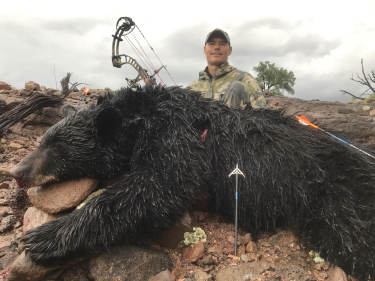
Patrick Feldt (owner/outfitter/guide) - Pat has operated as the outfitter of AZ Guided Hunts since 1997. He has personally guided hundreds of hunters during his career as a professional outfitter and guide. Pat is licensed in Arizona and obtains "Special Use" permits to operate his hunting business on certain Federal Lands. He has also completed the "Gila Wilderness Outfitter Course" in New Mexico and is trained in "Leave No Trace" practices. Pat rarely has time to hunt for himself since he is a full-time outfitter, but he has been fortunate enough to take many Arizona trophy-class animals in the past. Some of his "personal best" trophies include the former #8 SCI World Record black bear ( 21-11/16" skull, 7' 6" length, and 500lbs.), a 155 lb. desert mountain lion, an 84" record-class pronghorn antelope, many large Coues Deer, several large bull elk (one over 350 inches), multiple javelina, Merriam's and Gould's turkeys and many more. Additionally, Pat has successfully guided hunters to many record-class animals. One final note, Pat is a turkey hunting fanatic! He has completed the U.S. Royal Slam and has been known to travel anywhere across the country just to hunt another strutting gobbler!
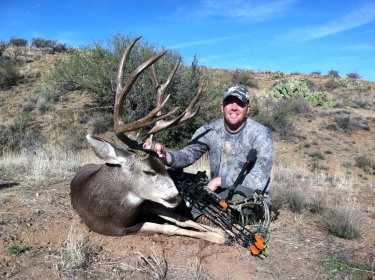
Jake Lindsey is a native of AZ, living in Tucson. Jake has been guiding since 2003. He's had the good fortune of helping quite a few hunters in his time as a guide; from pronghorn to bison to trophy bighorn sheep and Coues deer (which is his all-time favorite). Jake has enjoyed helping several hunters take "record book" animals. He has also managed to take a few for himself, both B&C and P&Y. If Jake is not at home with his 5 children and supportive wife, you'll find him on a hill somewhere glassing for animals. In addition to all of this, he has the best full-time job anyone could ask for as a firefighter paramedic.
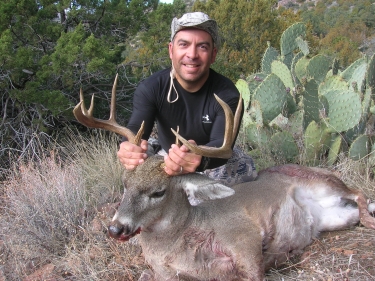
Eliot Anderson is also an Arizona native residing near Tucson. He has been guiding Arizona's various big game species with us since 2005. Although he likes to hunt all game species in Arizona, his true passion is Coues deer hunting. His remarkable skills have led him to take several record-class bucks, using both rifle and archery gear! When Eliot is not guiding or hunting, he is either spending time with his wife and two children or working as a Captain with the Fire Department.
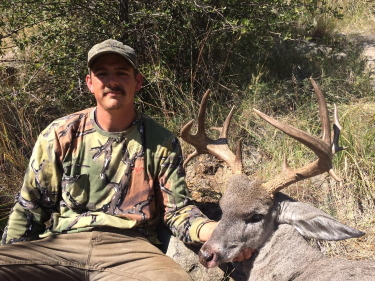
Andrew Nelson is a native of the State and loves hunting Coues deer in southern Arizona. It was in 2007 that he caught the Coues Bug and has either taken or been a part of taking multiple trophy Coues deer. He has 2 kids and when they're not fishing for flathead catfish, he is out in the hills. His full-time career is a firefighter for the city of Tucson.
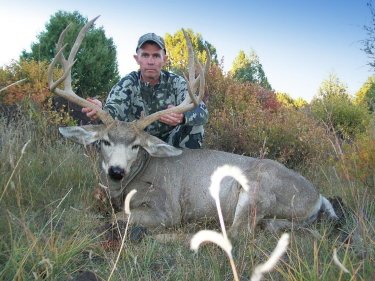
James "Jim" Comins was born and raised in Tucson before leaving Arizona to pursue a career in wildlife management. Jim retired after almost 25 years in the wildlife profession and is now a guide in both New Mexico and Arizona. Jim has over 30 years of experience in pursuing a variety of wildlife ranging from Coues deer, elk, and javelina in Arizona to antelope, elk, mule deer and bears in New Mexico. When Jim is not out in the field, he enjoys spending time with his wife and son.
Helpful Information About Your Hunt
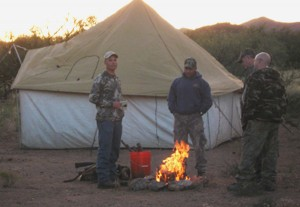 Accommodations:
Our complimentary accommodations are basic southwestern
style outfitter tent camps which are often located many miles from
civilization. Sleeping quarters for big game hunts are typically in
deluxe outfitter tents, unless noted otherwise. If you are looking for a hunt with fancy lodges, this is NOT the hunt for you!
Tent camps are used because we stay in remote areas. The
deluxe tents consist of large outfitter Kodiak Canvas brand tents. The size of our tents are tall and spacious
inside; typically 10X10 or 10X14 and stand 6.5 feet tall. The tents
are equipped with heaters during the colder months. Cots with thick
pads are provided, but all hunters must bring their own sleeping
bags. In most cases, hunters can bring their own camping trailer to
stay in, but we cannot discount the any hunt for doing so. It must
be high enough for ground clearance on rough dirt roads. Please ask
for road conditions before bringing one.
Video of our typical
camp.
Accommodations:
Our complimentary accommodations are basic southwestern
style outfitter tent camps which are often located many miles from
civilization. Sleeping quarters for big game hunts are typically in
deluxe outfitter tents, unless noted otherwise. If you are looking for a hunt with fancy lodges, this is NOT the hunt for you!
Tent camps are used because we stay in remote areas. The
deluxe tents consist of large outfitter Kodiak Canvas brand tents. The size of our tents are tall and spacious
inside; typically 10X10 or 10X14 and stand 6.5 feet tall. The tents
are equipped with heaters during the colder months. Cots with thick
pads are provided, but all hunters must bring their own sleeping
bags. In most cases, hunters can bring their own camping trailer to
stay in, but we cannot discount the any hunt for doing so. It must
be high enough for ground clearance on rough dirt roads. Please ask
for road conditions before bringing one.
Video of our typical
camp.
Complimentary Meals and bottled waters are provided on fully-guided/outfitted hunts. We serve quick breakfasts with coffee, mid-day lunches, and cooked, hot dinners. Snacks, Energy Bars, Trail Mix, etc., for snacking at camp and for your daypack are not provided, neither are your alcoholic or specialty beverages. Due to the law and liability, we will not provide your alcoholic beverages. If you drink, please bring your alcohol with you. Your own alcohol shall only be consumed off our time after the sun goes down or if you are done hunting for the day. If you are a big soda drinker, please bring your favorite soda with you.
Meeting Day/Time: Hunters are expected to arrive in camp about 1pm on the meeting day, unless specified otherwise. We do not provide transportation to/from airports, hotels or anywhere else. A predetermined meeting spot near the hunt area will be arranged. Hunters will follow us to camp from there. Non-resident flying hunters should get a flight into either Tucson or Phoenix and rent an SUV. Some past flying non-resident hunters have found it best to schedule a flight into Arizona the evening prior to meeting us, rent an SUV and get an airport hotel room. This eliminates loss of hunting time if your flight is delayed or cancelled, which is becoming a common occurrence. The meeting place could be 1 to 4 hours from any airport, depending upon which area we are hunting and which airport you flew into. With the exception of bighorn sheep, elk and antelope, most of our hunts are in the southeast portion of the state near Tucson. But, before booking a flight, it’s best to ask us which airport is most feasible for your particular hunt. Note: If coming on an elk hunt, there are now a couple flights daily into the Flagstaff Airport from a few major cities.
The roads from the meeting spot to the camp typically require at least an SUV for ground clearance purposes, but not necessarily 4-wheel drive though. So, whether driving here with your personal vehicle or flying/renting, choose a vehicle accordingly. After we meet, hunters will follow us in their vehicle to camp where they will be shown the camp accommodations. We will have a short briefing and safety meeting. Finally, we may have hunters shoot their weapons to confirm zero. If time permits, we may go afield to scout for the upcoming hunt or if the season is ongoing, we may go afield to get in an afternoon hunt.
Hotel: If flying in from another state, a hotel room should be considered on both ends of the hunt (prior to and after). The hotel stay is not included in our packages. The best approach is to book a room through the hotel's Internet site before you arrive. Most of our hunts are near Tucson, but please ask before booking a flight and renting an SUV. If hunting near Tucson, it's easiest to pick a hotel at the Tucson Airport. It's best to book a room for the day prior to meeting us and for the evening after the hunt. Flying non-resident hunters should also rent a vehicle from the airport.
Hunts end at noon on the last day (if the hunter didn't tag-out earlier). Hunters pack up and depart camp shortly thereafter. Hunters should expect to depart camp sooner if they tag out early. Flying non-resident hunters should get a flight that departs the day following the hunt, since travel time to the city can be up to a few hours. Therefore, an airport hotel room should also be considered following the hunt. Again, ask which part of the State we will be hunting before booking a hotel or flight.
Taxidermy: If you are successful, your game animal can be skinned and caped for taxidermy. If flying, you can transport your trophy cape and horns in a cooler and check it in as extra baggage (except for large elk antlers). To simplify things and if your hunt is near Tucson, we highly recommend using our taxidermist www.wellerswildlifestudio.com for your big game mount. If flying, it's best to transport your cape to our taxidermist after the hunt on the way back to the airport hotel. Hunters will be given directions to the taxidermist studio in Tucson. If coming on an elk hunt in the northern part of Arizona (near Flagstaff) and can't drive all the way to Tucson, we can recommend a few northern taxidermists to look at. Some hunters ship their horns/cape home via the UPS store or check them onto the plane as extra baggage. In that case, if you shot an elk, it's best to split the skull plate, as they won't allow a fell set of elk antlers. You would need to stop at a store to get a cooler or a long duffel.
Meat: You must take your game meat with you if you are successful. The game can be quartered for your transport. If you are driving/renting a vehicle, bring a tarp or cooler. If you are hunting in southern Arizona and want to use our Tucson butcher, WPG on Sweetwater Drive, the phone number is (520) 292-2262. If coming on an elk hunt in the northern part of Arizona (near Flagstaff), we can give you a few processors in that area to choose from. The best option for non-resident flying hunters is to transport the meat to an Arizona butcher on the way back to the airport hotels. The butchered meat can be shipped to you via next day air in approximately two weeks after the hunt. The second option is to take the game meat on the airplane and check it as extra baggage in a cooler with DRY ice (if your particular airline allows it).
Physical Aspects of the Hunt
The wild animals of Arizona usually live in rugged, mountainous terrain. Hunters are encouraged to condition themselves to the best of their ability in order to increase their odds for success. We do not use or even own horses or pack animals. Sometimes a successful hunter might encounter remote, rocky and steep areas in order to harvest game. There is nothing worse than getting sick from over-exertion or being sore for the duration of the hunt. Getting in-shape entails hiking a few miles several times a week, aerobics, mountain biking, and/or using a stair climber. "Hiking" does not mean walking on flat ground, but rather on an incline. If there are large hills or bleachers near your hometown, use them to your advantage and hike. The conditioning should start a few months ahead of time. Please consult your physician before starting any exercise regimen. Also, please break in your boots before you arrive. Hiking with new boots often causes blisters. These can be painful with every step and a bloody mess. Wear your boots when you do your conditioning for the hunt.
**A Note on MARKSMANSHIP**
 RIFLE
HUNTERS: Arizona is known for big canyon hunting.
Almost all big game species we hunt live in the mountainous terrain
or open country. The canyons in this type of habitat may be
large and wide open with little cover. This sometimes makes it
hard to get a close-in stalk. Animals may be spotted at vast
distances and stalked upon to cross-canyon shots. In this type
of country, it may be hard to get closer without being detected or
without the animal leaving the canyon before you get over to his
side. It’s hard to explain to an Eastern flat-lander or anyone that
hasn't hunted this type of country, but sometimes you just CAN’T get
any closer. Sometimes it is a must to take rifle shots from
across a big canyon if you want that trophy of a lifetime.
RIFLE
HUNTERS: Arizona is known for big canyon hunting.
Almost all big game species we hunt live in the mountainous terrain
or open country. The canyons in this type of habitat may be
large and wide open with little cover. This sometimes makes it
hard to get a close-in stalk. Animals may be spotted at vast
distances and stalked upon to cross-canyon shots. In this type
of country, it may be hard to get closer without being detected or
without the animal leaving the canyon before you get over to his
side. It’s hard to explain to an Eastern flat-lander or anyone that
hasn't hunted this type of country, but sometimes you just CAN’T get
any closer. Sometimes it is a must to take rifle shots from
across a big canyon if you want that trophy of a lifetime.
Most of our big game rifle shots are around 300 yards, but shooting at distances beyond 400 yards may be encountered while on your rifle hunt for black bear, elk, sheep, pronghorn, Coues, or desert mule deer. {Rifle javelina hunts are different in that the shots typically range from 100 yards to 300 yards with a 200 yard average.} Therefore, practicing at distances up to 400 yards will get you ready and build confidence for the "shot" you have been waiting for. A good high-power riflescope is the key to long range shooting. A 3-9X is insufficient for our rifle hunts, so please don't mount a 3-9x scope on your rifle! We recommend at least 4.5-14X. Most western hunters use around a 6.5-20X. Make sure to practice with the highest power setting. For those hunters who insist on using a low powered scope - A high powered scope will greatly improve your long distance shooting! Most of your shots will be in the prone position, but we also recommend practicing from all possible positions (sitting, kneeling, prone, standing). The most successful hunters are the ones that can adapt to the shot that is presented.
 We
often hear a hunter
say: “I sighted-in with 3 shots on a tin can at 100 yards off the
hood of my truck. I’m ready!” We know that guy just came for
an expensive "hiking trip" and will more than likely leave empty
handed. You should practice shooting a few times per month on
paper targets. Another good way to fine-tune your skills is by
shooting steel at your local 500 Meter silhouette range. We recommend practicing most of your rifle
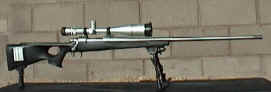
shooting with a 9"-13" or a 13.5"-23" Harris bipod while in the
prone position. This is the most accurate/precise field
position. Harris bipods are retractable
and mount to the sling studs on the rifle stock. They are relatively
lightweight and fold
forward when not in use.
We
often hear a hunter
say: “I sighted-in with 3 shots on a tin can at 100 yards off the
hood of my truck. I’m ready!” We know that guy just came for
an expensive "hiking trip" and will more than likely leave empty
handed. You should practice shooting a few times per month on
paper targets. Another good way to fine-tune your skills is by
shooting steel at your local 500 Meter silhouette range. We recommend practicing most of your rifle
shooting with a 9"-13" or a 13.5"-23" Harris bipod while in the
prone position. This is the most accurate/precise field
position. Harris bipods are retractable
and mount to the sling studs on the rifle stock. They are relatively
lightweight and fold
forward when not in use.
It is also recommended that you use a rest at the butt end of the rifle stock, as well as the bipod in the front, to make the gun more stable and to have 3 points of ground contact. Buy an empty leather rear rest and fill it with instant rice, or pillow stuffing, or foam, just NOT a heavy load of sand. A leather rest filled with sand would be too heavy while hunting in the field. You can keep the rest in your backpack. A tightly rolled up shirt or an extra small dry bag stuffed with a rain jacket is also another popular technique for stability at the rear of the gun. Trying to make long distance shots with the rear of the gun supported by just your shoulder could mean the difference between hitting and missing at long range. All match shooters rely upon a rear rest for 3-point stability. You wouldn't go to the rifle range with just a front rest and expect to get good groups, so why go into the field like that.
You should also obtain some sort of standing style shooting stick or hiking pole with a V yoke rest atop. A shooting stick that doubles as a hiking pole can also be beneficial on this loose, unstable rocky ground and will keep you from falling. Although standing is not a common shooting position in the field, it might be encountered on a javelina, mule deer or elk hunt. Practice your shooting skills also using this rest.
Please zero your rifle at 200 yards. Make or calculate a chart of the bullet drop at 50-yard increments from 200 to 500 yards (just in case) and tape it to your stock or scope. The chart should be a table showing the distance versus the bullet drop in either inches or minutes of angle (MOA). Also, if your scope has target turrets, learn how to use them. It is a far superior method than hold-over. Just find the range, look at the chart on your stock, click-in the MOA for that distance, and hold dead on the animal or target. There are also custom turrets that you can order from many riflescope manufacturers (Leupold CDS is one of them). Would you rather "hold and hope" or hold dead on? It is much more precise than “hold over” method. The "bar system" (for example B&C Reticle) on some scopes will work well, but most hunters use it incorrectly in an actual hunting situation. Most people using this bar system seem to miss long distance shots, causing them to go home empty handed. If you are using this system, remember to always use the correct power setting for your particular load when shooting at the animal.
Sample Ballistics Charts
| Yards | Inches |
| 200 | 0 |
| 250 | 2 |
| 300 | 6 |
| 350 | 11 |
| 400 | 17 |
| 450 | 25 |
| 500 | 35 |
| 550 | 46 |
| 600 | 60 |
Sample Ballistics Chart to tape to your rifle stock or scope (example: 300 Win. Mag.) - Hold-Over Method
| Yards | MOA |
| 200 | 0 |
| 250 | 1 |
| 300 | 2 |
| 350 | 3 |
| 400 | 4 |
| 450 | 5.25 |
| 500 | 6.5 |
| 550 | 8 |
| 600 | 9.5 |
Sample Ballistics Chart for your rifle stock - MOA Method (for scopes with target turrets). Click-in the MOA number on the dial and hold the crosshair where you want the bullet to go. No guessing, which is the main cause for misses.
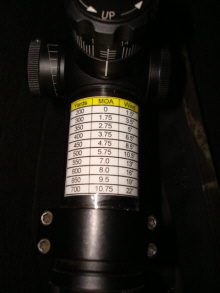
MOA Ballistics Chart taped to top of scope. Also shows 10mph wind hold (inches).
ARCHERY HUNTERS: Arizona is known for big canyon hunting. Almost all big game species we hunt live in the mountainous terrain. The canyons in this type of habitat may be large and wide open with little cover. This sometimes makes it hard to get a close-in stalk. It’s hard to explain to an Eastern flat-lander that only hunts in the forest or from a stand, but sometimes you just CAN’T get any closer. Your game animal may be stalked upon from vast distances. You might find yourself in a situation, because of topography or loss of cover, that you can only get within 30 to 70 yards. In this type of country, it may be hard to get closer without being detected. Sometimes it is a must to take shots from where you are if you want that trophy of a lifetime. Most of our archery shots are averaging 35 yards, but shooting at distances around 60 yards may be encountered while on your archery hunt for black bear, elk, sheep, Coues, or desert mule deer. Therefore, practicing at distances up to 60 yards will get you ready for the moment you have been waiting for. It should be noted that Javelina hunts are a different ballgame since these creatures have poor eyesight (they still have great ears and noses!). Javelina bowhunters have taken their trophies anywhere from 5 yards to 45 yards. The most successful bowhunters are the ones that can adapt to the shot that is presented. You should practice archery shooting a few times per week. We recommend practicing most of your archery shooting from different uphill and downhill angles, since we hunt mountainous terrain. You will always aim lower at any angle, whether it is uphill or downhill. If you are not comfortable with angles, there are a couple laser rangefinders on the market that compensate for angle variations and tell you the "true gravitational distance." Bushnell and Leupold offer a couple good, economical models. This takes all the guesswork out of it. Also, you shouldn't always rely on a rangefinder. Learn to judge and get a feel of different distances incase you don’t have time to use one in the actual archery hunting situation. And of course, take a few practice shots with the broadheads or practice heads that often come in the broadhead package. Most fixed broadheads will fly differently than field points.
Archery Broadhead Choice: There are two types of broadheads to choose from, fixed or mechanical. Which one to use is a highly debated subject and neither type is perfect. They each have their positives and negatives. As the hunt draws near, test the style of broadheads you will be hunting with (or the practice heads included in most broadhead packages). The ideal broadhead flies like a field point at long distance and produces a massive, blood-loss wound channel. If you are having trouble getting the fixed blades to fly like your field point at long distances, try paper tuning first. If that doesn’t work, try fletching your arrows with a helical twist or try a mechanical. Two-blade mechanicals with 2”+ diameter blades, such as Rage Hypodermic Trypan, are very popular here in the Southwest where long distance shooting is the norm. Besides these heads being very accurate, if the animal is hit poorly, which we see happen more often than not on our archery hunts, there is a much higher chance for recovery. We do not recommend a 3-blade mechanical though! If you don’t feel comfortable using a 2-blade mechanical, stick to a fixed blade because Fixed Blade vs Expandable is a highly debated subject with no conclusion “written in stone.” Note: From much experience, mechanical heads are only beneficial on archery bull elk hunts when the bull is shot broadside or only slightly quartered. So, keep this in mind when making your broadhead choice or shooting at a bull elk with a mechanical. Single bevel edge 2-blade fixed heads (like KuduPoint Broadheads) are a popular choice for bull elk hunting. We've seen them work well, even if the bull is quartered! Also, a lighted nock (like Lumenok or Nockturnal) is highly beneficial in tracking arrow flight and recovery of game. An alternative is the highly visible blaze orange vanes combined with blaze orange arrow wrap.
MUZZLELOADER HUNTERS: Our past muzzleloader elk hunters have shot their elk at varying ranges from as close as 60 yards to 280 yards and every distance in between, but the average is around 200 yards. Modern Magnum inline .45 and .50 caliber muzzleloaders are capable of making clean kills past 300 yards WITH THE PROPER LOAD, such as a 250-340 grain .50 caliber bullet coming out of the barrel at around 2000-2100 fps. Therefore, knowing your drop up to 300 yards can give you that “edge” on a muzzleloader elk hunt. Tape a drop chart to your stock. We recommend at least a 3-9X scope for your inline muzzleloader. The best option is to use a normal crosshair rifle scope on a muzzleloader and just hold for bullet drop or use the MOA turret. If you have a special muzzleloader scope with the bar system or BDC reticle, etc., make sure the aiming points are true to your ballistics. Use the scope manufacturers website to calculate what each aiming point means for your particular load and then TEST IT AT THE RANGE. Remember to always use the same power setting with a BDC. Those spaces between the lines change each time you crank down the power, ALWAYS causing a miss when not set to the correct power. In either case, make sure you have a drop chart taped to your stock (from 50 to 300 yds).
Muzzleloader Load Info: We recommend the highest powder charge possible for your particular gun to get the best long-range performance (without sacrificing accuracy of course). If you are looking to upgrade your current setup, Modern Magnum inline muzzleloaders, such as a T/C Omega, T/C Triumph, T/C Encore, Rem 700 Ultimate Muzzleloader, CVA Paramount or Accura MR/LR-X, etc., have long, stout barrels and are built for 150 grain pellet loads or 120 Volume Units of Blackhorn 209 loads. A velocity of 2000-2200 fps with a 250-340gr .50 caliber sabot bullet can be achieved in these modern Magnum muzzleloader rifles using up to 150 grains of Triple 7 and up to 120 (volume) of Blackhorn 209. It’s important to do your internet research and experiment to find a powder/bullet combo that will give you an accurate, high-velocity load to take down an 800-lb elk. Blackhorn 209 powder is preferred by most modern muzzleloader hunters because it burns much cleaner than pellets and is usually more accurate. Keep in mind, since it is loose powder, your powder charge in weight will be lower to match the velocities of those in pellet form.
Muzzleloader Bullet Choice: The new Hornady Bore Driver ELD-X 340 grain .50 caliber bullet has proven to be superior in ballistics due to its long profile and a high ballistic coefficient of .315 G1, which is beneficial on long shots past 300 yards. My 15-year-old muzzleloader gets ¾” groups at 100 yards using this bullet! The additional benefit to the Hornady ELD-X is that it does not need a fast twist rate barrel, which means you don’t need to go out and get a new muzzleloading rifle. It’s a great bullet and I recommend testing these in your muzzleloader. Another great .50 caliber muzzleloader bullet that has proven to be very lethal, especially on long range elk, is the sabot Barnes Spit Fire TMZ BOAT TAIL bullet. The plastic tipped boat tail version has a very high ballistic coefficient and is more streamlined for those long-range shots. It comes in .50 caliber only with 250gr and 290 versions. They do great tissue damage and typically give complete pass-through on big bull elk. I highly recommend testing either of these two boat tail bullets in your rifle, unless you have one of the new fast rifling twist rate barrels (around 1:20). In that case, you will need to use a special Power Belt bullet.
Special Notes to Consider
Packing for a Flight: Please don't ask to ship your luggage, weapon, ammo, etc., to our homes prior to the hunt. The best way to pack for a flight is to buy an extra large rolling duffel bag instead of a suitcase. A normal-sized sleeping bag will fit nicely into one of these. Also, bring your carry-on items onto the plane in your hunting backpack.
Like all hunting of true wild game, we cannot guarantee an animal. But, in order to increase your odds of taking home a trophy, please practice shooting before arriving and give some effort to prepare physically.
NOTE: It is UNETHICAL to return to an outfitter's/guide's hard-earned spots or tell others of their location. Please refrain from using a GPS app (having one in case of emergency is fine). Marking our spots will make your guide paranoid and you will soon find yourself in a less-to-be- desired hunting area. Just think, if you booked a hunt with us, we hike all the way to our destination and someone that we guided from the previous season (or someone they told) was in the spot that you were supposed to hunt. You would be very disappointed! Please be an ethical hunter and refrain from telling others or showing up to our spots after the hunt. It is unfair to other paying clients to have their hunt ruined by unethical behavior!
Our Policy: Cancellations, Terms, and Conditions
A minimum nonrefundable deposit (usually 50% of hunt cost) and a service contract is required upon booking a hunt. The remaining balance is due at least 21 days prior to the hunt. No hunt will be considered booked until the outfitter receives the deposit AND hunt contract. The deposit and/or any payments are nonrefundable. The hunt cannot be transferred from one person to another, except under one condition. A canceling hunter can transfer thier hunt to a replacement hunter only if the tags for the hunt are over-the-counter and not on a lottery draw. The hunter is responsible for finding their replacement. If the hunter cancels a hunt, the deposit will NOT be refunded; though, it can be applied towards any vacant hunt of equal or greater value and only if a permit or tag can be easily obtained (i.e. over-the-counter or high draw odds) for the rescheduled timeframe. The balance due will be adjusted if there is a difference in hunt fees. This rescheduling can only be done one time. Furthermore, if the hunter cancels and chooses to apply the deposit to another future hunt, the rescheduled hunt date must be within one year of the original hunt date. If a hunter schedules with a 2 on1 partner and the partner cancels, the canceling hunter loses their deposit and the remaining hunter will be required to pay the 1 on 1 rate.
There are no refunds. All hunts must be paid in full before any hunting takes place. Although the main goal is for each hunter to fill his tag or kill, it is not a guarantee. The hunter is not paying for an animal, but rather, for a hunt. The hunter assumes all risks involved in hunting. The outfitter or guide cannot control WHEN, WHERE, or IF the game will be found because wild game animals can be unpredictable. Sometimes animals may be found in steep or undesirable areas. The hunter assumes all risks associated with hunting. Once a hunter fills his/her tag, the hunt is over. There is no refund for unused days, such as: late arrivals, tagging-out early, departing early, bad weather, unexpected events, Acts of God or any event that may slow or stop a hunt. We break camp and depart if all hunters tag-out early; which means, for example, if all hunters in camp tag-out by the second day, the goal was accomplished and the hunt is over on that second day. A successful big game hunter that tags earlier than the other hunters has the option of departing if using his/her own transportation or staying until all hunters are finished. A hunter that bags the wrong animal type for his tag (e.g., doe, cow, hen, ewe) or exceeds the bag limit, even by mistake, will need to be reported to the authorities and the hunt will end. Hunters must also understand that qualified guides other than the outfitter may guide them. It is not possible for the outfitter (Pat Feldt) to personally guide all hunters.
The hunter must agree to abide by the hunting laws of Arizona. The hunter must also attest that they are NOT a prohibited possessor and that they are allowed by law to possess or carry legal deadly weapons, including firearms.
These terms and conditions are a common practice among most outfitters.
We strongly recommend cancellation/travel insurance for all of our guests. If you have an unexpected circumstance which causes a cancellation of your hunt or trip, outfitters and others in the travel industry will not refund your deposit. A cancellation/travel insurance policy is the solution. You can be reimbursed for monies forfeited if unforeseeable circumstance happen to occur. It is very reasonably priced (usually around 5% of travel/hunt costs) and well worth it. There are companies that offer plans specifically catered to hunting trips. Just Google search for travel insurance for hunting trips or speak to your insurance agent. Travel Guard Sportsman's is one of them.
Hunters interested in booking any hunt should contact us as soon as possible because spaces are limited and are filled usually 3 months to a year in advance.
Be sure to visit the list of items to bring.